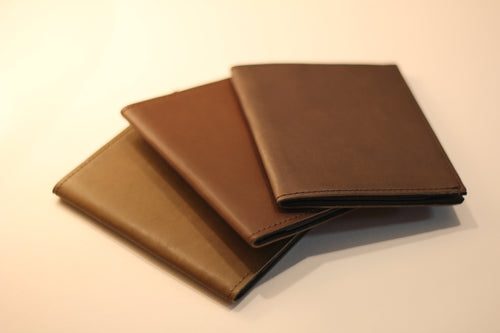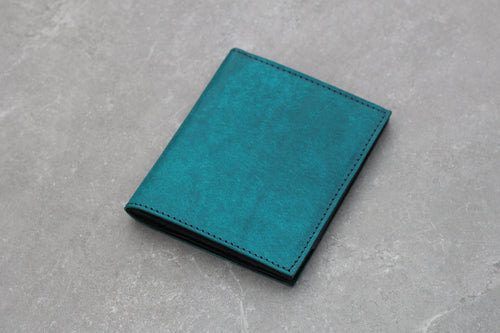
When designing compact and slim wallets, we place great importance on the selection of leather. While high-quality leather is generally associated with Europe, the goatskin we use originates from India and Pakistan and is sourced through Taiwan and other Southeast Asian countries.
In this article, we’ll discuss the appeal of goatskin—which is familiar yet surprisingly underappreciated—and the meticulous process through which it is transformed into a single, beautiful piece of leather.

The Finest Indian Hides, Nurtured by a Rich Natural Environment
Tracing the history of goatskin, India has long been known as a major hub for its production. The hides of goats raised in environments such as mountainous regions with significant temperature fluctuations feature extremely dense fibers, giving them astonishing strength even when thin. While the size of each hide is smaller compared to cowhide, its high density is a key characteristic.
The Tanning Process at Asian Tanneries
While there are renowned tanneries for goatskin in parts of Europe, much of SOLAHANPU’s goatskin is tanned in various Asian countries along the route from India to Japan.
Transforming raw hides into usable leather requires numerous meticulous steps. The process begins with soaking—thoroughly rinsing the salt-cured hides—followed by depilation, which uses lime to remove hair and excess fat. The suppleness of the final leather depends on how carefully this pretreatment is performed.
After that, the tanning process begins. A tanning agent called chrome is added to massive wooden barrels, and it is allowed to penetrate deep into the fibers over a long period of time.This is followed by skiving—a process of precisely shaving the leather to the correct thickness in 0.1-millimeter increments to match the wallet’s specifications—dyeing to achieve a uniform color, and finally, fat-tanning to restore the appropriate level of oil content.
While the Italian leather used by SOLA is characterized by vegetable-tanned leather that retains its natural character, we deliberately use chrome-tanned goat leather.The reason for this is that while tannin tanning is certainly suitable for preserving a natural texture and scent, we seek the toughness and elasticity of goatskin; in this regard, chrome tanning produces a stronger leather. Consequently, we are able to create a combination where the exterior of the wallet is made of cowhide with a natural texture, while the interior is made of chrome-tanned goatskin that meets the functional requirements.
The Overwhelming Characteristics of the Finished Goatskin as a Functional Item
The goat leather produced in this way possesses a unique charm found in no other leather.
-
A Balance of Thinness and Strength: Because the fibers are extremely fine and intricately intertwined, the leather remains tear-resistant even when thinned to the absolute limit and offers exceptional elasticity. (This is an essential feature for the twin card slots in the Tenuis series.)
-
A Distinctive, Beautiful Grain and Texture: The surface features a unique, fine, uneven pattern known as “grain,” which gently diffuses light to create elegant shadows. It feels soft and supple to the touch, and its resistance to showing scratches is another practical advantage.
-
Lightweight: Given its exceptional durability relative to its weight, it is the ideal material for creating minimalist wallets that feel virtually weightless even when carried in a pocket.
Unlike vegetable-tanned leather, which develops a rich patina over time, chrome-tanned goatskin does not undergo significant aging. Conversely, this means it retains its initial beauty and strength for a long time—it has a tough and functional side, so to speak.
Tenuis Zipper Type (Canvas Version)
https://solahanpu.com/products/tenuis-zipper-canvas
Tenuis Zipper Type
https://solahanpu.com/products/tenuis-zipper
Tenuis Flap Type
https://solahanpu.com/products/tenuis-flap