Good evening, this is Sola, a designer.
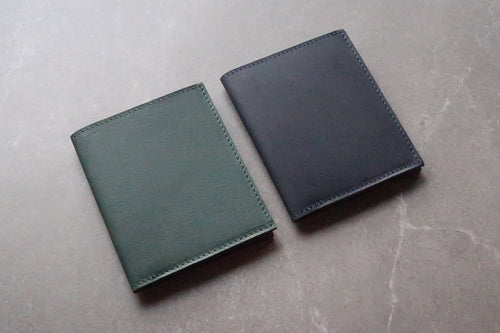
Today, I’d like to share the story of “Litt,” a card-sized mini wallet we developed some time ago, as part of our brand’s journey in product design.

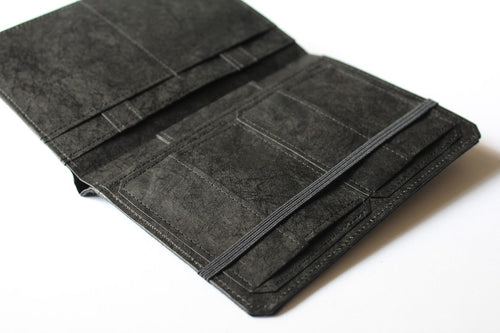
Unlike the Tenuis series, which features a bi-fold design, this wallet was an experiment to see “just how compact we could make a tri-fold wallet.”The exterior is made of canvas—which represents the brand’s origins—while the interior features supple goatskin. Writing this just reminded me: the goatskin we later used for the Tenuis series was actually first used in this Litt!
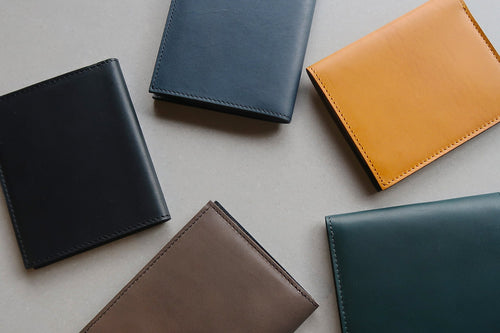
That said, it didn’t end up becoming as popular as the Tenuis. However, we learned a lot through the production process, and it had a positive influence on our subsequent design philosophy.
The Dilemma Unique to the “Tri-Fold” Structure
After releasing the Litt, we received a lot of feedback from our users, and there was something we realized for the first time: a clear divide in preferences regarding “tri-fold wallets” and the structural challenges they present.
I believe we successfully achieved the “small size and thinness” we aimed for with the tri-fold design. However, because we designed the wallet to fold tightly to maintain its thinness, the bills inside end up with distinct creases. This led to negative feedback, such as, “The bills curl up when I hand them over at the register, making them hard to handle.”
On the other hand, if we design the folding section to be gentle and rounded to prevent creases on the bills, the wallet itself ends up puffing out into a round shape, losing its compactness. I keenly realized just how difficult it is to balance thinness and ease of use in a tri-fold wallet.
Eliminating buttons and adopting a clever cord mechanism
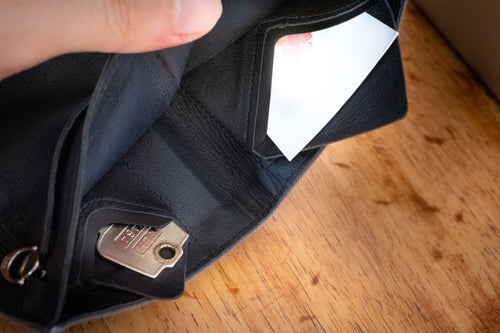
Unlike bifold wallets, trifold wallets tend to open on their own due to their structure. While they typically feature fasteners like buttons or snaps, at the time I didn’t want the wallet to become bulky due to the thickness of the buttons, so I opted for an old-fashioned method of closing it by pulling a cord.
The mechanism works like a little “contraption.” When you hook the loop on the wallet and give the cord on the back a firm pull, the loop tightens and the wallet closes securely. Conversely, to open it, you slide the back cord in the opposite direction; this enlarges the loop, releases the lock, and opens the wallet.
Adopting this cord system may not have been the right choice from a commercial standpoint. However, this slightly unusual mechanism sparked my curiosity as a designer, and driven by the single-minded desire to “take on an interesting challenge that no one else has attempted,” I enjoyed the development process itself.
The Future of Minimalist Wallets
To be honest, there isn’t currently much demand for tri-fold wallets, nor do I have any great ideas for them right now. But if the time comes again, I believe I’ll be able to create something even better than before. As I mentioned in another blog post a little while ago, I’m currently developing a mini version of the Tenuis bifold wallet, so I expect to be able to share more details about that in the near future.