When choosing a "slim wallet," many people probably check the "thickness of 〇mm" listed in the specifications. However, knowing whether that refers to "when it's empty" or "when it's full," and how much the thickness differs between those two states, can make it easier to choose a wallet.

Currently, slim and compact wallets on the market can be categorized into several structural types. By understanding the characteristics of each, you can find the truly slim wallet that suits your usage.
1. Wallets where coins and cards do not overlap (fixed volume type)
This is the current mainstream type of wallet that achieves slimness by preventing cards and coins from overlapping. Since this type is designed so that cards and coins are stored side by side, it has the innovative advantage of not becoming thick when contents are inserted.
On the other hand, due to its structural characteristics, most of these wallets have a pre-formed, three-dimensional compartment designed for the maximum storage capacity (e.g., 8 cards, 15 coins, etc.). This means that "even when empty, a certain volume (thickness) is fixed from the start."
2. The "variable type" adopted by the Tenuis series
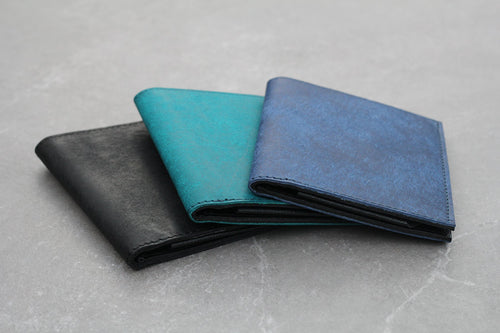
In contrast, SOLAHANPU's slim compact wallet "Tenuis" series has a thickness of only 6mm when nothing is inserted.
You might think, "It's natural for it to be thin if nothing is inside, isn't it?" However, traditional wallets are already thick even when empty, and they swell even more as soon as contents are added.
The Tenuis series starts from a low position of "6mm" with all unnecessary bulk removed, and adopts a variable structure where "only the minimum thickness required for the contents is added." Therefore, if you primarily use it minimally with few contents, you can keep the overall thickness to a minimum.
Advantages and choices for each structure
Of course, both structures have their own merits. The type where cards and coins do not overlap also has the advantage that the thickness does not change within a fixed capacity.
In fact, SOLAHANPU's other slim compact wallet line, "Tynd," also belongs to this non-overlapping type. However, Tynd employs a unique special gusset structure designed to "collapse and shrink as much as possible when empty." This allows it to leverage the convenience of the non-overlapping type while also approaching the slimness of the starting point.
The "starting point of slimness" and the "way it bulges" are not visible from the numbers in the specifications alone. Choose the optimal form of subtraction based on your usual storage capacity.
Tenuis Zipper Type (formerly Tenuis 3rd generation) Canvas version (scheduled to be restocked soon)
https://solahanpu.com/products/tenuis-zipper-canvas
Tenuis Zipper Type (formerly Tenuis 3rd generation) (our best-seller)
https://solahanpu.com/products/tenuis-zipper
Tenuis Flap Type (formerly Tenuis 4th generation) (scheduled to be restocked soon)
https://solahanpu.com/products/tenuis-flap