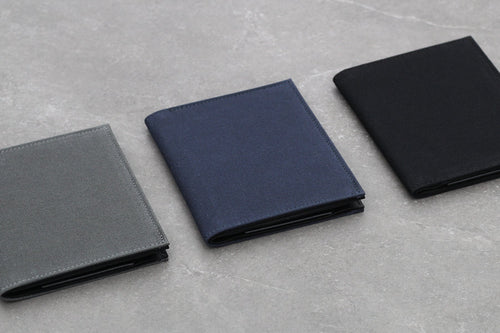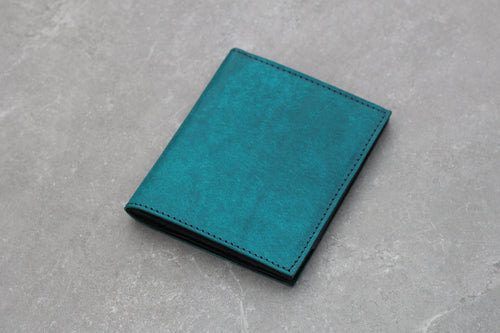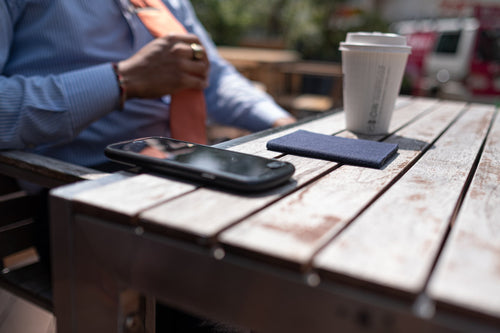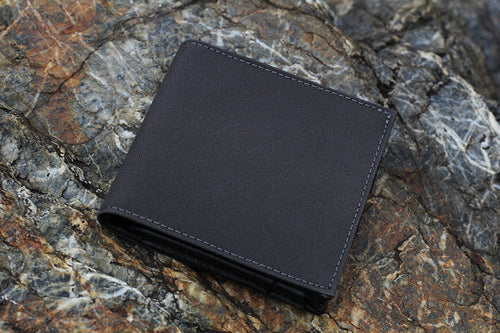
Over the past few years, we have seen an increasing number of thin, compact wallets in stores and online. Our company first began working with thin wallets around 2009, long before a cashless society was on our radar. However, since 2016, the spread of cashless payments and the emergence of many manufacturers entering the thin wallet market through crowdfunding have brought the "compact wallet" option to the mainstream. In this article, we would like to summarize our perspective on why these wallets have become so popular.

First, as a premise, we believe that thin wallets possess an inherent appeal. Many men, in particular, seem to intuitively appreciate the way a slim wallet sits flat in their pocket. There are also practical advantages: they don't spoil the silhouette of a suit or jacket, and they aren't uncomfortable to sit on when kept in a back pocket. Combined with a general trend toward carrying only what is essential and keeping one's belongings organized, thin wallets have enjoyed steady support for some time.
A major catalyst for this was the shift toward a cashless society. According to data from the Ministry of Economy, Trade and Industry, Japan’s cashless payment ratio was around 20% in 2016, but it has gradually increased to over 40% in 2024. In 2016, Apple Pay launched in Japan with the iPhone's Osaifu-Keitai support. Around 2018, QR code payments began to spread, and the point-reward system was introduced during the 2019 consumption tax hike. As a result, more people are carrying less cash than before. When you have less cash, you don't need a wallet with a large capacity. Making wallets smaller and thinner has become a natural choice.
Another factor is crowdfunding. Since the mid-2010s, an increasing number of businesses have used crowdfunding to announce new wallet designs. This has allowed even small-scale manufacturers to bring their ideas to the market, leading to the introduction of numerous wallets characterized by their thinness and small size. As the range of choices has grown, the entire category of compact wallets has become more visible to a wider audience.
However, we believe that simply making a wallet with less capacity just because cashless payments have reduced the need for cash is not particularly innovative. If you just make it smaller, you just end up with less space to put things. To make a wallet truly thin, you need structural ingenuity—thinking about how to overlap cards and bills, and how to minimize seam allowances and material thickness. While SOLAHANPU is aware of the cashless trend, we have worked diligently to ensure that our wallet structures remain thin regardless of the amount of cash carried. We aim for our wallets to remain slim whether you have a lot of cash or very little.
Furthermore, we do not believe that Japan's cash culture will disappear anytime soon. Due to the complex interplay of cultural and political factors, we expect cash to remain in circulation. In fact, many countries in the West and Asia are further ahead in cashless adoption than Japan. While each country has its own circumstances, Japan can be considered a country where cash continues to be used relatively frequently. The variety of Japanese coins, which are used daily from 1-yen to 500-yen coins, may be one reason why it is difficult to eliminate coins from our wallets.
Even if the amount of cash continues to decrease, it is unlikely that the wallet itself will become obsolete. Beyond cash, there are still many cards we carry: IDs, insurance cards, credit cards, bank cards, transit IC cards, and loyalty cards. While more items are being consolidated into smartphones, it seems it will take time for everything to move entirely to digital.
The item we carry most often and keep closest to us in our daily lives is surely the wallet. Many people may go a day without a bag, but few go without their wallet. This is precisely why it is essential for a wallet to be thin and small, yet perfectly capable of holding what is necessary. We believe the demand for compact, user-friendly wallets will continue, regardless of how far the cashless transition progresses.
Tenuis Zipper Type (formerly Tenuis 3rd Gen) Canvas Version
https://solahanpu.com/products/tenuis-zipper-canvas
Tenuis Zipper Type (formerly Tenuis 3rd Gen)
https://solahanpu.com/products/tenuis-zipper
Tenuis Flap Type (formerly Tenuis 4th Gen)
https://solahanpu.com/products/tenuis-flap