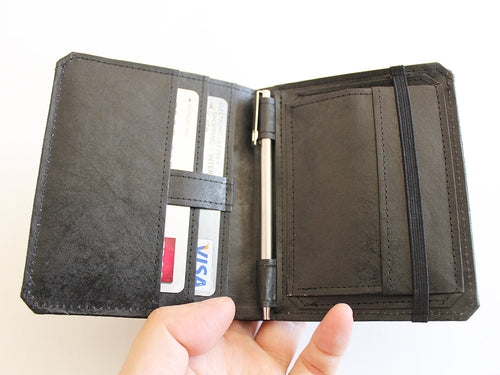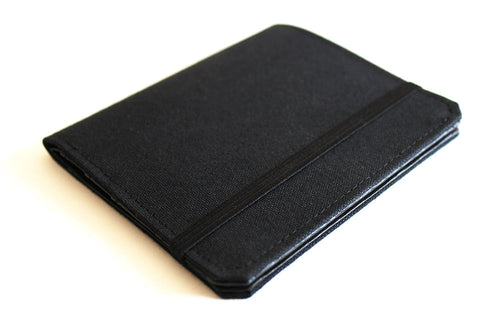
Currently, there are many different types of "thin wallets" on the market. Each brand has its own unique features and innovations. However, broadly speaking, most of them are the type shown on the left in the diagram, where cards and coins do not overlap. The type on the right in the diagram is the Tenuis type.

In the limited space of a wallet, it's a physical inevitability that pursuing one aspect will inevitably affect something else. Objectively examining not only the numbers on the specifications sheet, but also how the structure contributes to usability, is crucial when choosing a wallet you can cherish for a long time.
Differences in approach based on structure
Type where coins and cards do not overlap:
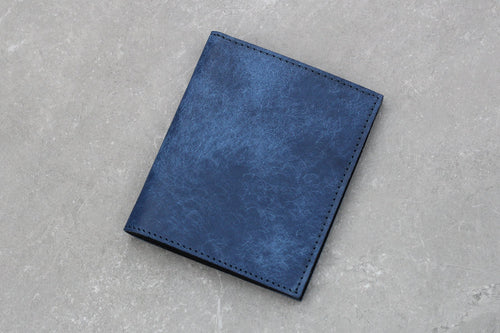
This is the most common type, and since a certain manufacturer developed it around 2009, various manufacturers have used this structure as a reference when making wallets. Its characteristic feature is that the cards and coins do not overlap, but many types allow banknotes to be visible. SOLAHANPU's Tynd is also of this type. The thickness and bulge of the leather tend to be noticeable, so if it's not carefully calculated, it may not feel as thin as it should.
Cards arranged in parallel:
I believe this structure is almost unique to SOLAHANPU's Tenuis wallet. After the Tenuis was released, several card cases with similar structures appeared, but those from other companies have a "gusset" in addition to the area required for two cards side by side, which makes them quite large. The Tenuis has almost no gusset, so it doesn't expand much when you put cards side by side.
Identify your own priorities.
The key to avoiding regrets when choosing a wallet is not to compete based on numerical superiority or inferiority, but to clarify "what you prioritize" in light of your own lifestyle.
- I value both thinness and small size.
- Do you want to maintain a slim profile while retaining the same feel and operation as a conventional wallet?
- Do you prioritize storage capacity and accept a certain level of size?
There isn't one single correct structure; each is a "solution" to a different problem.
At SOLAHANPU, we prioritize the balance when the product is filled with contents and the harmony of a comfortable feel in your hand, rather than creating an unrealistic design to achieve specific numerical values. While referencing excellent designs from other companies, we will explore the criteria for determining what "ease of use" you truly desire, from a designer's perspective.
Tynd card and coin design prevents overlapping.
https://solahanpu.com/products/tynd-cv
Tenuis 3rd Generation
https://solahanpu.com/products/tenuis-third
Tenuis 4th Generation
https://solahanpu.com/products/tenuis-fourth